


What is the battle over the Constitutional Tribunal all about?
Is judicial review of the constitutionality of laws necessary? Who should be the guardian of the constitution? Is it really the courts? And if so, is a special constitutional court necessary? It seems obvious that the answer to all these questions should be ‘yes’. But this has only been the case for a short time.
Before the Second World War, constitutional courts existed only in Austria (from 1919), Czechoslovakia (from 1920), Liechtenstein (from 1921), Greece (from 1927) and, very briefly, in Spain from 1931. Their powers, however, were usually quite limited. After the Second World War, constitutional courts also existed in only a few countries – initially only in Italy and Germany, and later in France, Spain, Portugal and Belgium. It is striking that in almost all cases these were unstable, newly formed states or those emerging from an endogenous dictatorship. The political model in which constitutional courts, with the power to review the constitutionality of laws and other legal acts, are regarded as an essential element of democracy only became dominant after the collapse of real socialism.
// Schmitt has a notorious reputation, as he became an advocate of the totalitarian state and supported Hitler. However, his views were borne out by reality. ///
Two well-known German legal theorists, Hans Kelsen and Carl Schmitt, once debated this issue. Kelsen, an Austrian, was in favour of establishing a constitutional court – and went on to become a judge there. He believed that without such oversight, the constitution would remain nothing more than a wish list. Schmitt, on the other hand – a ‘Reichsdeutscher’ – argued that a special court with such powers would not be a legal institution, but a political one. The decision as to what the constitution stipulates and what it does not must always – given the generality of constitutional law, which allows for many interpretations – be a political decision, not a legal one. Every genuine dispute concerning the constitution is always political. It is impossible to separate legal issues from political ones; therefore, he believed it would be more honest for constitutional disputes to be settled by a political rather than a legal body. Otherwise, instead of the jurisdiction of politics, there would be a politicisation of the judiciary.
The issue was a politically charged one in Germany at the time, because in the Weimar Republic, conservative lawyers – who had once, during the Empire, spoken out against judges being able to review the constitutionality of laws – had changed their minds, as they feared a parliament dominated by left-wing forces. The left, on the other hand, wanted to shield parliamentary legislation from the influence of the judiciary, which at that time was sceptical of parliamentarianism.
Schmitt is notorious for having become an advocate of the totalitarian state and for supporting Hitler. However, his view has been borne out by reality: in developed democracies, courts in many countries, by expanding their powers, have begun not only to interpret the law creatively but even to create it. They have thus effectively assumed a political role – ruling not only on how to interpret fundamental constitutional principles and values, but also on how they are to be put into practice, thereby becoming centres of social engineering in line with those values. They were meant to protect the law from politics, but have begun to make political decisions. That is why the German political scientist Philip Manow rightly asked who protects politics from the law.
In the United States, it has long been recognised that the rights of an elected parliamentary majority to implement its policies are undermined by the judiciary. This has been described as the ‘countermajoritarian difficulty’, in discussions exploring why and on what grounds unelected judges can legally oppose the decisions of a democratically elected majority. Even those legal theorists who are ardent supporters of constitutionalism acknowledge that there is a conflict between democracy – and thus political decisions – and the rights defended by the courts and constitutional tribunals. ‘Democracy can undermine the law. The law can stifle democracy,’ writes the German constitutionalist and former judge of the Federal Constitutional Court, Dieter Grimm. He believes that legal fundamentalism leads to the decline of democracy. Judges usurp the right to decide on fundamental policy directions, invoking human rights, amongst other things, even if the majority of citizens oppose this. This is the case with asylum policy and climate policy.
/// The Constitutional Tribunal is one of the last barriers against Tusk’s absolute power. After all, no one is under any illusion that it is he, and not Anna Krowin-Piotrowska, who is orchestrating the whole operation, and that he will head the Constitutional Tribunal if the whole operation succeeds. ///
Was the Constitutional Tribunal in Poland independent and apolitical? As we know, it was established as early as 1986. Even then, its judges were guardians of the constitution. However, I do not recall them causing any trouble for Generals Jaruzelski and Kiszczak. And were, or are, Andrzej Zoll, Marek Safjan or Jerzy Stępień independent and apolitical? In their political obstinacy and obsequious partisanship, they surpass many politicians. The fact that Poles failed to recognise the political nature of the Constitutional Tribunal was simply due to the monopoly on power. Its case law was in line with the political agenda of the ruling camp of the Third Polish Republic. Everything began to change when voters decided to entrust power to a political camp with a completely different programme. During the United Right’s time in government, references to the rule of law by the European Commission and legal circles were intended to restrict, or even prevent, the government’s actions.
That is why the law and the courts, including, above all, the Constitutional Tribunal, have become the main political battleground. Now the tables have turned. The Constitutional Tribunal is one of the last bulwarks against Tusk’s absolute power. After all, no one is under any illusion that it is he, and not Anna Krowin-Piotrowska, who is directing the whole operation, and that he will head the Constitutional Tribunal if the whole operation succeeds. The Constitutional Tribunal is an extremely important institution within the political system. More important than the Senate. It can legitimise or delegitimise political decisions – even those which the people do not want. Tusk’s camp ignored and marginalised the Constitutional Tribunal for as long as it held out hope that Rafał Trzaskowski would become president. Now, the Constitutional Tribunal has become indispensable for overcoming the president’s resistance and legitimising fundamental decisions that could not be implemented through political and democratic channels.
In a healthy state, however, judges are part of the state elite; they have a sense of responsibility towards the state and towards the law. Responsible lawyers exercise restraint in their actions and creativity; they do not push interpretations to the point of absurdity by exploiting the characteristics of natural language.
Poland is not a healthy state. A vast majority of lawyers are people consumed by a lust for power, convinced of their superiority over the people. Associations such as Iustitia and Themis are fanatical political organisations. The fundamental difference between the current situation and the past does not, therefore, lie in the fact that the Constitutional Tribunal used to be neutral, independent and apolitical, whereas now – let us say since 2015 – it has become political.
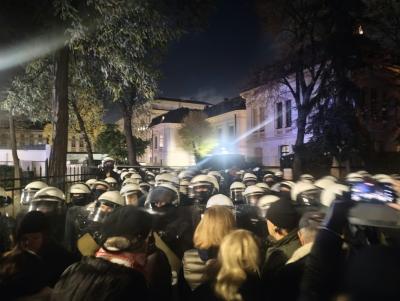
/// Those demonstrating against the coup d’état are rightly concerned that the Constitutional Tribunal, now under Tusk’s control, will legitimise the destruction of the state by recognising the primacy of European law. ///
The fundamental difference lies in the political stance reflected in the Constitutional Tribunal’s rulings. During the PiS era, it upheld the primacy of the Polish Constitution over EU law. Those demonstrating against the coup d’état are rightly concerned that a Constitutional Tribunal controlled by Tusk will legitimise the destruction of the state by recognising the supremacy of European law. In the case of Poland and other EU member states, the conflict between politics and the law becomes all the more dramatic because political decisions are taken by external courts, outside our national legal system, which seek to reorganise the law and the judiciary in Poland. This is the case with the CJEU. As Dieter Grimm wrote: “Although the European treaties are, by their very nature, international treaties, the Court of Justice of the European Union has, from the very beginning, interpreted them not as international law but as national law.”
Through its rulings, it is implementing a programme to build a European state. A significant proportion of Polish judges and lawyers recognise this objective and the role of the CJEU. We must therefore consider in future whether the Constitutional Tribunal is still needed in its current form. It seems that in a country as polarised as Poland, an additional supervisory body is necessary. But should it be staffed by judges? There is a prevailing view that judges and lawyers – unlike politicians – are less dependent on the political climate and on public pressure, and that they are less ‘political’ and more ‘neutral’ and independent. Recent years have shown this to be an illusion.
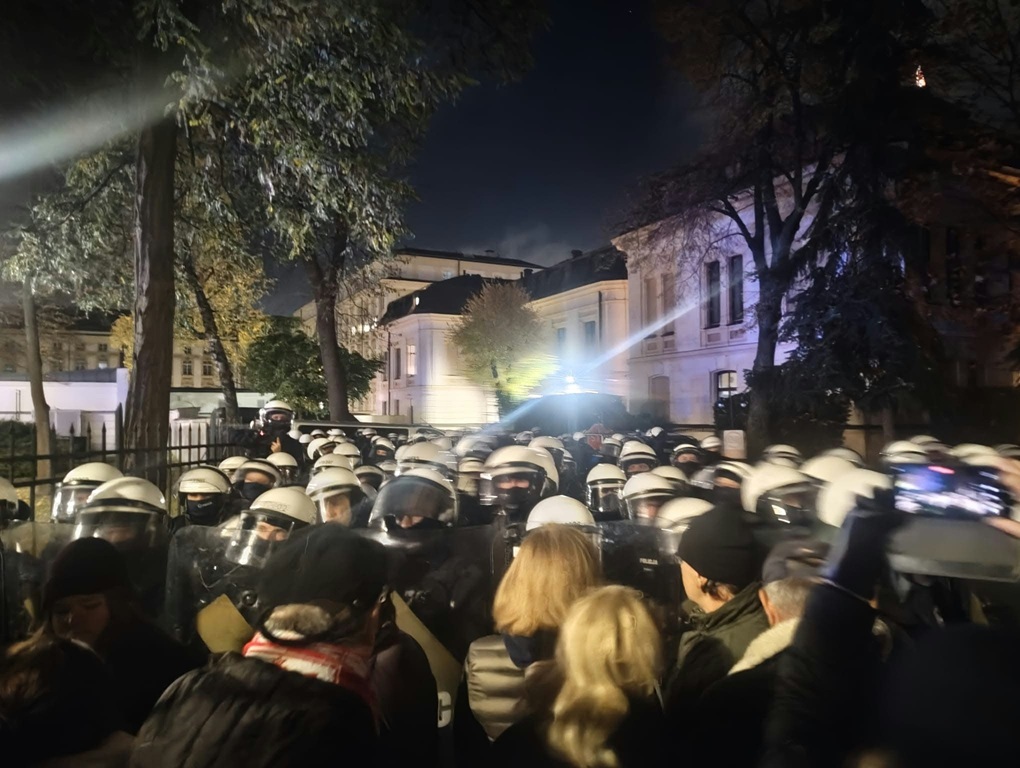
In this situation, the future constitution should replace the Constitutional Tribunal with a Council of State, comprising figures of public trust who do not take part in party politics, such as former presidents. For now, however, the Constitutional Tribunal must be defended, as this is not only a defence of democracy and freedom, but also of Polish statehood and independence. The people gathering on Aleja Szucha understand this perfectly well.
The column was published in Tygodnik Solidarność / issue 45/2026.
Photo: AO
Read also





Seen from Warsaw, Seen from Brussels: 'Zeitenwende' in Polish - turning something on its head.
For years, the German government has pursued a policy of rapprochement with Russia, despite the country’s brutal wars in Chechnya, Georgia, Syria, and Ukraine, despite the assassinations for which the Putin regime was responsible.
Comments (0)